The Three Factors That Legally Come First
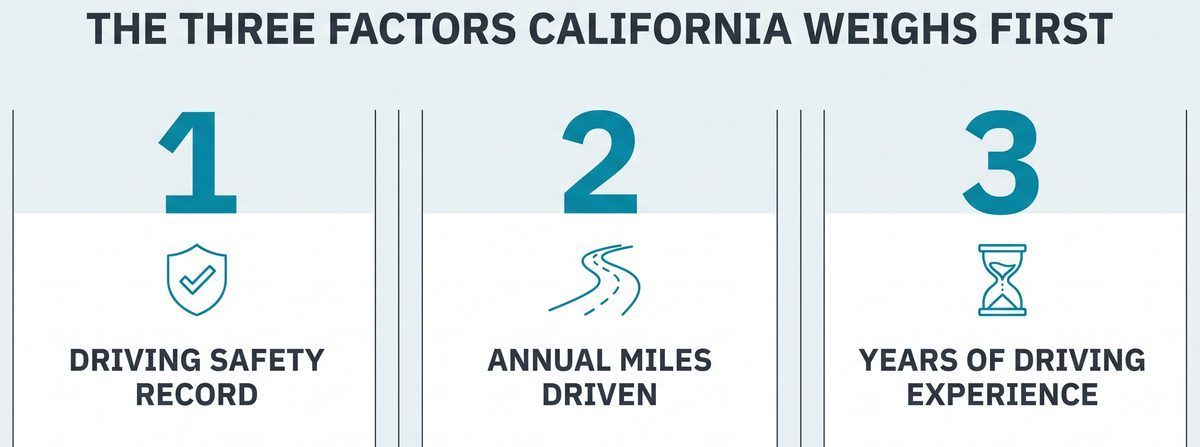
California doesn't leave auto insurance pricing entirely to the companies. State law requires that private passenger auto rates rest primarily on three things about you — and knowing which three tells you where your effort actually pays.
1. Your driving safety record
Tickets, at-fault accidents, and the absence of them. This is the heaviest lever most drivers have, and it works slowly and quietly: every clean year strengthens your position with every carrier at once. Nothing else you do compounds like this.
Auto World Insurance Services has a dedicated page on why your quote is higher than a friend's for the statewide picture.
2. Annual miles driven
How far you actually drive in a year. This is the factor most people report inaccurately — usually guessing high "to be safe," which means paying for miles they never drive. Measure your real commute and multiply by the days you actually make it. A precise number here is free money for many drivers.
3. Years of driving experience
Not your age — the time you've held a license. A 30-year-old licensed last year and a 30-year-old licensed at 16 are different profiles at identical ages. It's the one factor you genuinely cannot influence, and it improves on its own.
What sits behind those three
Everything else — vehicle, ZIP, coverage choices, how long you have been with that company — still counts, and each company weighs it under its own filed plan. That's why identical inputs produce different quotes at different companies: the primary factors are mandated, but the rest of the arithmetic belongs to each insurer.
Want to see how your three read across several carriers? Two minutes.
Two of the three improve on their own
There is something genuinely encouraging in how this is structured. Years of driving experience only ever increases, and a driving record improves as incidents age out of relevance. Both move in your favor without you doing anything except continuing to drive carefully. The practical consequence is that your profile is different every year — which is the strongest argument there is for requoting annually rather than renewing on autopilot and never finding out.
Get this quoted for your situation
Free quotes from multiple carriers, prepared by a licensed California agent. Two minutes, no obligation.
Get My Free QuoteMore of what callers ask
Does my age set my rate in California?
Years of driving experience is the mandated factor, not age by itself. They correlate for young drivers — a 19-year-old usually has few years of experience — but they're different inputs, and an adult licensed late is priced on the experience, not the birthday.
How do I find my real annual mileage?
Take your odometer now and a year ago if you have a record — service invoices and registration renewals often show it — or measure your round-trip commute and multiply by the days you actually drive it. Precision beats a cautious guess.
Does a clean record eventually erase an old ticket?
Recent history carries the most weight, and the effect of an old violation fades as clean time accumulates. How fast is each company's own rating plan, which is why re-comparing during that fade finds the carriers who moved on first.