Whether They Will Write You, and What They Will Charge
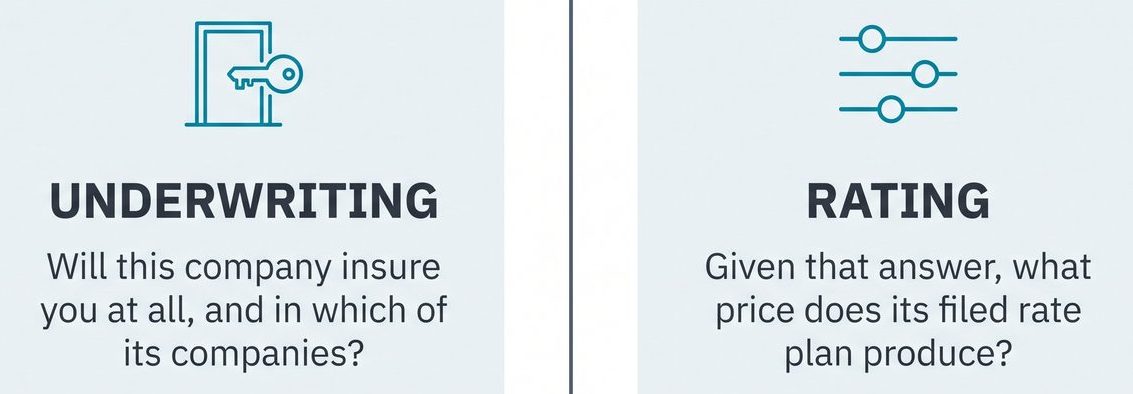
Two separate decisions happen when you apply for insurance, and drivers routinely blur them into one. Underwriting decides whether the company will take the risk. Rating decides the price if it does. They use overlapping information and reach independent conclusions, and knowing which one you are running into changes what you should do next.
Underwriting: the yes-or-no gate
A company's underwriting rules define its appetite: what kinds of drivers, vehicles, uses and histories it wants. It is a business judgement about which risks belong in its book. This is why a serious conviction can be a problem even for someone willing to pay more — the answer is not "expensive", it is "no".
Rating: the how-much gate
Once the company will write you, the filed plan determines the price from your characteristics. It has no discretion in it. That is why nothing is negotiable at this stage.
The same rules, statewide, are in the Auto World Insurance Services guide to why your quote is higher than a friend's.
Where drivers get stuck
Applying repeatedly to companies whose underwriting will not accept the situation, collecting declinations, and concluding that insurance is unaffordable. It is not a pricing problem; it is a matching problem. The fix is knowing which companies write the situation — which is genuinely most of the value a broker adds for a difficult risk.
Things that are underwriting questions more than rating questions
- Serious violations and the time since them.
- Business use and vehicles used commercially.
- Unusual vehicles: heavily modified, salvage-titled, very high value.
- Claim frequency, as distinct from claim fault.
- Prior cancellation for non-payment or for misrepresentation.
What California guarantees regardless
The good driver policy is an entitlement rather than an appetite question — a driver who meets the criteria in Insurance Code section 1861.025 is to be offered one by an insurer writing that kind of policy. And drivers who cannot find coverage in the ordinary market have a statutory route through the state's assigned risk plan, which also houses the Low Cost Automobile Insurance Program established under Insurance Code section 11629.7 for income-eligible drivers. Nobody in California is genuinely without a path.
Tell us the hard part first — it saves everyone the application-by-application version of this.
Get this quoted for your situation
Free quotes from multiple carriers, prepared by a licensed California agent. Two minutes, no obligation.
Get My Free QuoteMore of what callers ask
I was declined. Does that go on a record?
Applications and their outcomes can be visible to other insurers through industry reporting, which is one reason scattering applications is a poor strategy. Work out where you fit before applying.
Is being placed with a non-standard company bad?
It is a company whose underwriting accepts situations others decline, and it is a normal part of the market. What matters is that it is a licensed, admitted California insurer — ask, and verify with the Department of Insurance if you want certainty.
Can a company cancel me after underwriting has already accepted me?
There are limits, and California regulates cancellation and the notice required — see Insurance Code section 662. Misrepresentation on the application is a different matter, which is the practical argument for accuracy at the start.